


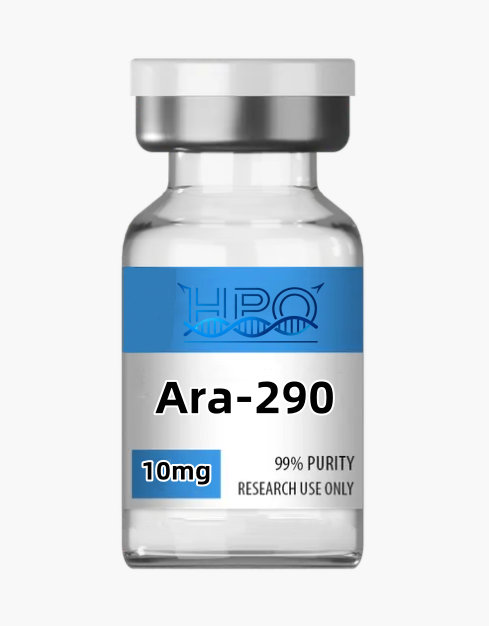
Ara-290
$60.00
ARA-290 (cibinetide/PHBSP) is an 11-amino-acid erythropoietin-derived research peptide used to study EPOR/CD131 innate-repair signaling, neuroinflammation, and tissue-protection pathways. 10 mg × 10 vials; laboratory research only—not for human or animal use.
DISCLAIMER:
ARA-290 Peptide: Comprehensive Cibinetide Research Guide
ARA-290 peptide, also known as cibinetide, pyroglutamate helix-B surface peptide (pHBSP/PHBSP), or helix-B surface peptide, is an 11-amino-acid synthetic research peptide modeled on a three-dimensional surface region of erythropoietin (EPO). It was designed to help investigators separate EPO-associated tissue-protective signaling from the classical receptor signaling responsible for red-blood-cell production. ARA-290 is consequently studied as a selective probe of the proposed innate repair receptor, a heteromeric complex involving the EPO receptor (EPOR) and the common beta receptor subunit CD131.
This product is supplied solely as laboratory research material. Research topics reported in the literature include receptor pharmacology, cellular stress responses, neuroinflammation, small-fiber biology, tissue injury, ischemia-reperfusion models, and biomarker development. Those topics describe experimental uses and early clinical research; they do not establish that a catalog research product is safe or effective as a medicine. ARA-290 is not supplied for injection, self-experimentation, diagnosis, treatment, or human or animal administration.
Molecular Identity and Physicochemical Profile
| Product name | ARA-290 peptide |
|---|---|
| Common research synonyms | Cibinetide, pHBSP, PHBSP, helix-B surface peptide |
| Peptide length | 11 amino-acid residues |
| Sequence | pE-E-Q-L-E-R-A-L-N-S-S (N-terminal pyroglutamate) |
| Molecular formula | C51H84N16O21 for the registered neutral substance |
| Relative molecular mass | Approximately 1257.31 Da |
| CAS Registry Number | 1208243-50-8 |
| Listing configuration | 10 mg × 10 vials |
| Appearance | Lot-dependent vialed research material; verify against the lot-specific certificate and inspection record |
| Purity and identity | Confirm using the lot-specific certificate of analysis and independent HPLC/UHPLC and mass-spectrometric testing |
| Research-use restriction | Laboratory research only; not for human or animal use |
The sequence and molecular identifiers above are consistent with the U.S. FDA Global Substance Registration System record for cibinetide. A registry entry establishes substance identity; it is not evidence of marketing authorization or clinical approval. The experimentally measured mass of a supplied lot may reflect salt form, counterions, hydration, or analytical method, so investigators should compare observed data with the lot documentation and method-specific expectations.
Relationship to Erythropoietin
EPO is a much larger glycoprotein hormone whose classical EPOR homodimer signaling supports erythropoiesis. ARA-290 is not EPO and does not reproduce the complete EPO molecule. Instead, its short sequence was engineered to mimic the spatial presentation of residues on EPO’s helix-B surface. The central research hypothesis is that this constrained molecular surface can engage an injury-associated receptor complex without appreciably activating the classical erythropoietic receptor pathway.
This distinction is important for experimental interpretation. “EPO-derived” refers to the structural design concept, not to extraction from human EPO and not to equivalence with recombinant EPO. ARA-290 should be treated as its own defined peptide analyte. Receptor selectivity, potency, stability, and downstream responses must be measured in the actual model under study rather than inferred from EPO literature.
Proposed Mechanisms Studied with ARA-290
1. EPOR/CD131 Innate Repair Receptor Engagement
The most widely discussed mechanism is selective interaction with a heteromeric receptor containing EPOR and CD131, often called the innate repair receptor (IRR). This receptor model is distinct from the EPOR homodimer associated with erythropoiesis. Cell and animal studies have used receptor expression, ligand-response assays, genetic loss-of-function models, and downstream phosphorylation measurements to investigate whether ARA-290 responses require CD131. The proposed selectivity makes the peptide useful for comparing tissue-protective signaling with classical EPO signaling.
2. Injury- and Stress-Dependent Receptor Availability
IRR components are reported to become more relevant in stressed or injured tissue. Oxidative stress and inflammatory signals can alter CD131 localization and receptor availability, creating a context-dependent response. Researchers should therefore measure baseline and stimulated EPOR/CD131 expression instead of assuming that every cell line expresses a functional receptor complex. Surface localization, not total-cell abundance alone, may be critical.
3. Modulation of Pro-Inflammatory Signaling
Experimental studies describe changes in tumor-necrosis-factor-associated and NF-kappa-B-related signaling following IRR activation. These findings are usually framed as modulation of an injury response rather than generalized immune suppression. Useful endpoints include cytokine release, nuclear translocation, transcription-factor activation, chemokine expression, and temporal recovery after removal of a stressor. Vehicle, unstressed, stress-only, and receptor-blocked controls help distinguish a pathway-specific effect from nonspecific changes in cell viability.
4. Cytoprotection and Apoptosis-Related Pathways
ARA-290 has been studied in models that quantify mitochondrial stress thresholds, caspase activity, membrane integrity, and survival after hypoxic, inflammatory, or oxidative challenge. Reported cytoprotective patterns may involve PI3K/Akt, MAPK/ERK, JAK/STAT, and other context-dependent signaling networks. These pathways are broadly responsive to stress, so an observed phosphorylation change is not sufficient on its own to prove IRR specificity. Orthogonal receptor-dependency experiments are essential.
5. Neural Repair and Neuroinflammatory Phenotypes
Neuropathy models have examined allodynia-related behavior, inflammatory cell activation, chemokine expression, axonal integrity, and small-fiber regeneration. Early human studies used patient-reported symptoms together with corneal confocal microscopy, skin-biopsy markers, sensory testing, and walking performance. The use of structural and functional measures is scientifically valuable because symptom scores can be influenced by placebo response and day-to-day variability.
6. Microvascular and Ischemia-Reperfusion Responses
Preclinical kidney, cardiac, and cutaneous-injury models have investigated whether alternative EPO signaling changes inflammation, microvascular patency, fibrosis, or organ-function markers after injury. These studies support mechanistic hypotheses but do not demonstrate a clinical indication. Species, injury severity, timing, assay choice, and supportive care can materially change an outcome and should be defined before the experiment begins.
7. Regeneration-Associated Biomarkers
Corneal nerve-fiber area and regenerating intraepidermal GAP-43-positive fibers have been used as candidate biomarkers in cibinetide research. Such measures may reveal a biological signal that differs from symptom change. A robust study should predefine image-acquisition settings, masking, sampling regions, segmentation rules, repeatability limits, and the relationship between structural biomarkers and functional endpoints.
Research Evidence and Its Limits
Sarcoidosis-Associated Small-Fiber Neuropathy
A small randomized, double-blind pilot study enrolled 22 participants with sarcoidosis and symptoms of small-fiber neuropathy. Over four weeks, the active-treatment group showed a larger improvement than placebo on the Small Fiber Neuropathy Screening List, while some pain and fatigue measures improved similarly in both groups. The study reported no safety signal in its short observation window, but its sample size, duration, and exploratory design limit broad conclusions.
Subsequent randomized studies examined structural markers. A 28-day study reported increases in corneal nerve-fiber measures and changes in other neuropathy-related endpoints. A later phase 2b study of 64 subjects compared multiple groups and found a statistically significant placebo-corrected change in corneal nerve-fiber area in one group, while not every group or endpoint met significance. These results are appropriate for hypothesis generation and biomarker research; they should not be presented as proof of routine therapeutic efficacy.
Type 2 Diabetes and Neuropathy Research
A separate exploratory study evaluated ARA-290 in people with type 2 diabetes and neuropathic symptoms. The publication reported changes in neuropathy measures and metabolic variables, but it was a limited early-stage investigation. Replication in larger, independently powered trials with longer follow-up would be necessary to characterize durability, clinical relevance, and safety. Laboratory researchers can use the work to select mechanistic endpoints without treating it as a treatment recommendation.
Preclinical Tissue-Injury Models
Animal studies have examined renal ischemia-reperfusion injury, neuropathic injury, burns, inflammatory neuritis, and cardiac remodeling. Reported outcomes include changes in inflammatory mediators, tissue architecture, nerve-related behavior, microvascular injury, or organ-function markers. These findings depend on species and protocol and cannot be directly converted into human expectations. Preclinical studies should include blinded assessment, prespecified exclusions, suitable power calculations, and complete reporting of null as well as positive findings.
Recommended Analytical Characterization
Identity confirmation should precede receptor or phenotype experiments. Reversed-phase HPLC or UHPLC can assess retention behavior and chromatographic purity, while electrospray or MALDI mass spectrometry can confirm the principal molecular ion. Where resources permit, tandem MS can provide sequence-supporting fragment information. Amino-acid analysis, peptide mapping, or high-resolution MS can supply additional orthogonal evidence.
Purity by area percentage is method-dependent and does not identify every possible impurity. Researchers should document wavelength, column chemistry, gradient, mobile phase, injection amount, integration rules, and detection threshold. Residual solvent, water, counterion, bioburden, or endotoxin testing may be relevant depending on the experimental system. A certificate of analysis is useful documentation, but it does not replace fit-for-purpose verification by the receiving laboratory.
Experimental Design and Controls
- Confirm model competence: measure EPOR and CD131 abundance and, when possible, cell-surface localization under baseline and injury conditions.
- Use matched controls: include vehicle, untreated, stress-only, positive-control, and sequence or receptor-dependency controls appropriate to the assay.
- Establish concentration-response and time-course relationships: choose ranges from pilot experiments and assay sensitivity, not from human-use claims found online.
- Separate viability from pathway effects: pair signaling or cytokine endpoints with cytotoxicity, cell-count, and metabolic controls.
- Use orthogonal readouts: combine biochemical, imaging, transcriptional, and functional endpoints rather than relying on one marker.
- Reduce bias: randomize samples, mask image and behavioral analysis, predefine exclusions, and retain raw data and metadata.
- Report the material: document supplier, lot, sequence, salt form, purity method, storage history, and preparation procedure used in the laboratory.
Laboratory Handling and Stability
Handle ARA-290 as a bioactive research chemical of uncertain hazard unless a laboratory-specific risk assessment establishes otherwise. Qualified personnel should use appropriate personal protective equipment and engineering controls, avoid aerosol formation and direct contact, and keep the material away from food, medicines, and clinical supplies. The package quantity is a supply specification, not an experimental concentration or administration amount.
Store unopened vials according to the lot-specific label, certificate of analysis, and laboratory SOP. Protect the material from unnecessary heat, light, moisture, contamination, and repeated temperature cycling. If analytical sample solutions are prepared, document solvent, pH, nominal concentration, container material, preparation time, freeze-thaw history, and acceptance window. Conduct a stability study rather than assuming that a solution remains intact after storage.
This page intentionally does not provide injection, self-administration, human dosing, or treatment instructions. Solvent compatibility and sample preparation must be established for the specific analytical or in vitro method by trained laboratory personnel. Dispose of unused material and contaminated consumables under the institution’s chemical and biological waste procedures and applicable local requirements.
Frequently Asked Questions
1. What is ARA-290 peptide?
ARA-290 is an 11-residue synthetic peptide also known as cibinetide or pHBSP. It was designed from the helix-B surface of erythropoietin and is used to investigate proposed EPOR/CD131 innate-repair signaling. It is not full-length EPO and is not supplied as a medicine.
2. Is ARA-290 the same as erythropoietin?
No. EPO is a large glycoprotein hormone, whereas ARA-290 is a short defined peptide. The design seeks to reproduce one tissue-protective molecular surface while avoiding classical erythropoietic receptor activation. Similarity of design does not make the two molecules interchangeable in an assay.
3. Does ARA-290 stimulate red-blood-cell production?
The peptide was designed to avoid appreciable activation of the classical EPOR homodimer, and experimental reports describe it as nonerythropoietic. That is a research characteristic, not a guarantee about an unverified material or a statement of clinical safety. Receptor selectivity and hematologic endpoints should be tested when relevant to the study.
4. What is the strongest human research evidence?
Published early-stage randomized studies in sarcoidosis-associated small-fiber neuropathy reported signals in symptom and nerve-fiber endpoints. The studies were short and relatively small, and results varied by endpoint and group. They support continued investigation but do not establish approved therapeutic use.
5. How should researchers confirm ARA-290 identity?
Use at least two complementary methods. A common workflow combines chromatographic assessment with intact-mass measurement and, when appropriate, tandem-MS or amino-acid analysis. Compare results with a qualified reference, document method performance, and investigate unexpected peaks or mass differences before biological testing.
6. How should the material be stored?
Follow the lot-specific documentation and the receiving laboratory’s validated SOP. Minimize moisture exposure, light, heat, contamination, and repeated temperature cycling. For prepared analytical samples, establish stability under the actual solvent, pH, container, concentration, and storage conditions used in the method.
7. Can this product be used in people or animals?
No. This listing is strictly for laboratory research. It is not supplied for injection, ingestion, topical application, veterinary use, diagnosis, prevention, or treatment. The catalog vial size must never be interpreted as a dose.
Related Research Materials
- SS-31 — a mitochondrial-targeting peptide used in bioenergetics and cellular-stress research.
- MOTS-c — a mitochondrial-derived peptide investigated in metabolic-stress signaling.
- VIP — a neuropeptide research material for receptor, barrier, and immunoregulatory studies.
- BPC-157 — an experimental peptide used in tissue-response and repair-pathway models.
- TB-500 / Thymosin beta-4 — an actin-binding and tissue-repair research peptide.
- LL-37 — a host-defense peptide studied in innate immunity and inflammation.
- KPV — a short alpha-MSH-derived peptide used in inflammatory-signaling research.
- NAD+ — a metabolic cofactor for redox, bioenergetic, and cellular-stress studies.
- Semax — a synthetic peptide investigated in neurobiology research.
- Selank — a synthetic peptide used in neurochemical and behavioral research models.
Quality Documentation
Hanpro Peptides supplies research materials for qualified laboratory use. Lot evaluation may include chromatographic purity testing, mass-spectrometric identity confirmation, visual inspection, fill verification, and review of production documentation. Availability and exact test panels can vary by lot, so researchers should request the applicable certificate of analysis and confirm that its methods, specifications, and date meet the needs of the planned experiment.
Receiving laboratories remain responsible for independent identity confirmation, method suitability, chain of custody, storage qualification, and compliance with institutional and local requirements. Do not infer sterility, endotoxin status, or suitability for a biological system unless those properties are explicitly tested and documented for the specific lot.
Selected Scientific and Regulatory References
- U.S. FDA Global Substance Registration System. Cibinetide (UNII 9W5677JKDA), including names, sequence, formula, molecular mass, and identifiers. View the substance record.
- Heij L, et al. Safety and efficacy of ARA 290 in sarcoidosis patients with symptoms of small fiber neuropathy: a randomized, double-blind pilot study. Read the full paper.
- Dahan A, et al. ARA 290 improves symptoms in patients with sarcoidosis-associated small nerve fiber loss and increases corneal nerve fiber density. Read the full paper.
- Culver DA, et al. Cibinetide improves corneal nerve fiber abundance in patients with sarcoidosis-associated small nerve fiber loss and neuropathic pain. View the PubMed record.
- Brines M, et al. ARA 290 improves metabolic control and neuropathic symptoms in patients with type 2 diabetes. Read the full paper.
- Burger D, et al. Modulation of cellular stress response via the erythropoietin/CD131 heteroreceptor complex in mouse mesenchymal-derived cells. Read the full paper.
- van Rijt WG, et al. ARA290, a non-erythropoietic EPO derivative, attenuates renal ischemia/reperfusion injury. View the PubMed record.
Research-use disclaimer: ARA-290 is supplied exclusively for laboratory research by qualified professionals. It is not a drug, food, cosmetic, dietary supplement, or veterinary product and is not supplied for human or animal consumption or administration. Nothing on this page is medical advice or an instruction for diagnosis, prevention, treatment, injection, or self-experimentation. Investigators are responsible for legal review, ethics approval, risk assessment, method validation, safe handling, and compliance with all applicable institutional and jurisdictional requirements.
| Specification | 10mg*10vials |
|---|
Only logged in customers who have purchased this product may leave a review.
Related products



Reviews
There are no reviews yet.