

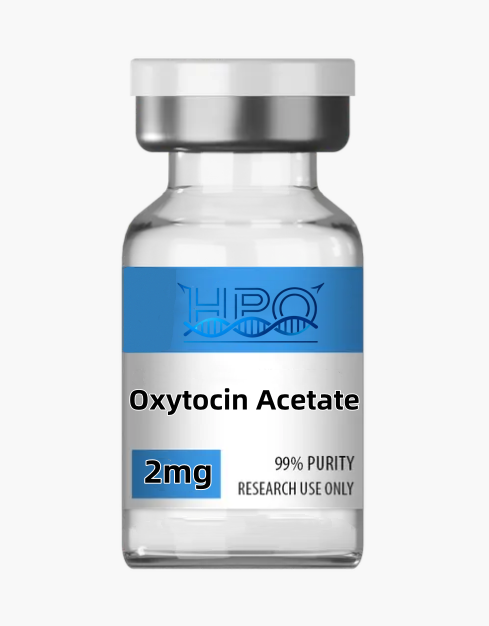
Oxytocin Acetate
Price range: $30.00 through $70.00
Oxytocin acetate is a cyclic nonapeptide research material for OXTR signaling, receptor pharmacology and assay-development studies. Review identity and analytical quality; for laboratory research only, not human or veterinary use.
DISCLAIMER:
Oxytocin Acetate Research Peptide: Identity, OXTR Signaling and Study Design
Oxytocin acetate is a laboratory research material based on oxytocin, a cyclic nine-amino-acid peptide that functions as a hormone and neuromodulator. Researchers use it to examine oxytocin receptor (OXTR) pharmacology, peptide–receptor interactions, intracellular signaling, tissue responses and analytical methods. This page describes the material from a research perspective and separates established molecular facts from findings that depend on species, tissue, dose, route, assay format and experimental context.
This catalog product is supplied for controlled laboratory investigation only. It is not a medicine, diagnostic product, food, cosmetic ingredient or veterinary product. It must not be used for self-experimentation or administered to humans or animals outside properly authorized institutional research. Approved oxytocin injections are regulated drug products with defined formulations, manufacturing controls and clinical labeling; a catalog oxytocin acetate research peptide is not interchangeable with those medicines.
Identity and structural features
| Property | Research reference |
|---|---|
| Peptide name | Oxytocin |
| Catalog form | Oxytocin acetate; counterion identity and amount should be confirmed on the lot documentation |
| Sequence | Cys-Tyr-Ile-Gln-Asn-Cys-Pro-Leu-Gly-NH₂ (CYIQNCPLG-NH₂) |
| Architecture | Cyclic nonapeptide with a disulfide bond between Cys¹ and Cys⁶ and an amidated C-terminus |
| Oxytocin formula | C₄₃H₆₆N₁₂O₁₂S₂ |
| Oxytocin molecular weight | 1007.2 g/mol for the oxytocin moiety |
| Primary research target | Oxytocin receptor (OXTR), a class A G-protein-coupled receptor |
| Intended use | Laboratory research only |
The disulfide-bridged ring is central to oxytocin conformation and receptor recognition. Reduction, disulfide scrambling, oxidation, deamidation or backbone cleavage can change assay behavior, so intact mass alone is not always sufficient to establish functional identity. Orthogonal characterization can include chromatographic purity, mass spectrometry, disulfide-bond confirmation and, when relevant, peptide mapping.
“Acetate” describes a counterion associated with the peptide preparation; it does not mean that acetate replaces part of the oxytocin sequence. The amount and stoichiometry of acetate can vary with synthesis, purification, isolation and drying. Researchers comparing lots or preparing molar solutions should use the stated net peptide content and counterion information from the batch-specific certificate rather than assuming a single universal formula or molecular weight for every acetate preparation.
OXTR signaling and receptor selectivity
OXTR is commonly coupled to Gq/11 proteins. Receptor activation can stimulate phospholipase C, generate inositol phosphates, mobilize intracellular calcium and engage downstream kinase pathways. Depending on cell background, receptor density and ligand exposure, additional G-protein coupling, beta-arrestin recruitment, receptor internalization and desensitization may contribute. A response in one engineered cell line should therefore not be treated as a complete model of signaling in native tissue.
Oxytocin and vasopressin systems are structurally related. At some concentrations, oxytocin may interact with vasopressin receptor subtypes, while vasopressin analogs may show activity at OXTR. Selectivity should be established within the actual assay window rather than inferred from ligand name alone. Useful controls include receptor-null cells, matched parental cells, concentration-response curves, selective antagonists where validated, and parallel testing against relevant vasopressin receptors.
Signal amplification also matters. Calcium-flux assays can detect rapid events, while reporter-gene or transcriptional assays integrate signaling over a longer period and may magnify small differences. Time course, ligand depletion, receptor reserve and normalization strategy should be defined before comparing potency or efficacy across platforms.
Evidence boundaries in oxytocin research
Reproductive and smooth-muscle models
Oxytocin has established physiological roles in uterine contraction and milk ejection, making receptor-expressing smooth-muscle or myoepithelial systems useful mechanistic models. However, an isolated-tissue response is shaped by species, hormonal state, receptor expression, tissue preparation and bath conditions. Such experiments are not clinical dosing protocols and do not establish the suitability of a research reagent for medical use.
Neural, social and behavioral models
Oxytocin research includes social cue processing, affiliation, stress responses and learning. Reviews emphasize that effects are not uniformly prosocial or beneficial. Outcomes can vary with context, individual characteristics, prior experience, experimental design and measurement quality. Behavioral observations should be supported with appropriate blinding, preregistered endpoints, power calculations and replication rather than interpreted as a simple “bonding” effect.
Route and compartment questions
Intranasal studies have generated hypotheses about central and peripheral mechanisms, but route-to-brain delivery, pharmacokinetics and causal compartment remain active methodological questions. Peripheral concentration changes do not automatically demonstrate direct central exposure. This catalog page does not provide route, dose or administration instructions; route selection belongs within an approved study protocol supported by pharmacokinetic and assay-specific evidence.
Measurement limitations
Endogenous oxytocin measurement is technically challenging. Sample collection, anticoagulant, extraction, matrix effects, storage, freeze-thaw history, assay antibodies and calibration can all affect results. Immunoassays, chromatography-coupled mass spectrometry and other platforms may quantify different molecular pools. A peripheral measurement should not be used as a simple surrogate for central signaling without validation.
Experimental planning with oxytocin acetate
1. Receptor pharmacology
Confirm OXTR expression and choose a readout matched to the biological question. Include a vehicle control, a broad concentration range, replicate wells and an independent positive control. Where selectivity matters, profile the material against relevant vasopressin receptors under comparable conditions. Report the exact cell line, passage range, receptor construct, incubation time and analysis model.
2. Cellular signaling
For calcium, inositol phosphate, cAMP, ERK or beta-arrestin studies, separate early signaling from longer-term receptor adaptation. Establish whether the response is OXTR-dependent with genetic or pharmacological controls. Monitor solvent, buffer composition, plate material and peptide adsorption, particularly at low working concentrations.
3. Tissue and ex vivo studies
Record tissue source, physiological state, preparation method, baseline tone, oxygenation and normalization procedure. Randomize treatment order when practical and account for desensitization between challenges. Interpret contractile or secretory responses as model-specific mechanistic data, not evidence of clinical safety or efficacy.
4. Neural and behavioral research
Predefine primary endpoints and distinguish exploratory analyses from confirmatory tests. Use balanced allocation, blinded scoring, appropriate controls and sufficient sample size. Track environmental and social context because these variables can interact with oxytocin-related outcomes. Avoid translating a single model directly into claims about human personality, trust, attachment or psychiatric treatment.
5. Analytical method development
When developing an assay, evaluate recovery, linearity, precision, selectivity, matrix interference, carryover and stability under the exact collection and storage conditions. Use calibrators and quality controls appropriate to the platform. If a method cannot distinguish intact oxytocin from fragments or cross-reactive molecules, describe that limitation explicitly.
Quality documentation and lot-specific review
No fixed purity, content, acetate level, endotoxin value or shelf life should be assumed from a generic product description. Review the certificate of analysis for the specific lot. Depending on the intended experiment, relevant attributes may include:
- identity by mass spectrometry and, where needed, sequence or peptide mapping;
- chromatographic purity with a stated method and integration approach;
- net peptide content rather than gross vial mass alone;
- counterion identity and amount, residual water and residual solvents;
- related peptides, oxidation products and disulfide-linked variants;
- bioburden, endotoxin or sterility only when specifically tested and documented;
- storage conditions, retest date and chain-of-custody records.
Purity percentage and peptide content answer different questions. A chromatographic area percentage does not by itself state how much active peptide is present per milligram of powder. For quantitative comparisons, calculate concentration from the batch-specific peptide content and document the mass basis used.
Handling and storage principles
Follow the conditions on the product label and lot documentation. Keep the container sealed and protect it from moisture, light and unnecessary temperature cycling. Before opening a cold vial, allow it to equilibrate while sealed to reduce condensation. Select a research buffer only after considering pH, ionic strength, compatibility with the assay and possible adsorption to plastic or glass.
For solution studies, prepare only what the protocol requires, use low-binding materials when validated and minimize repeated freeze-thaw cycles. Establish solution stability for the actual concentration, container, buffer and temperature. Do not assume a universal refrigerated or frozen solution lifetime. Inspect chromatographic profiles or functional controls when degradation would materially affect interpretation.
Frequently asked questions
What is oxytocin acetate?
It is an oxytocin peptide preparation associated with acetate counterion. The peptide sequence remains oxytocin; acetate does not replace an amino acid or the C-terminal amide.
Is oxytocin acetate the same as an approved oxytocin injection?
No. Approved injections are specific regulated drug products. This catalog material is an oxytocin acetate research peptide and is not a substitute for any prescription medicine or clinical formulation.
What molecular weight should be used?
Oxytocin itself has a molecular weight of approximately 1007.2 g/mol. For molar preparation, consult the lot documentation for peptide content, water and counterion information rather than adding a fixed acetate mass by assumption.
Does oxytocin act only at OXTR?
OXTR is the primary target, but concentration-dependent activity at vasopressin receptors can be relevant. Use receptor-selectivity controls when mechanism attribution matters.
Can peripheral oxytocin measurements represent brain signaling?
Not automatically. Central and peripheral compartments, pulsatile release, collection methods and assay limitations complicate interpretation. Validate the relationship within the specific model.
What controls improve an OXTR experiment?
Useful controls include vehicle, receptor-null or matched parental cells, validated antagonists, time courses, concentration-response curves, orthogonal readouts and lot-matched analytical checks.
How should this material be handled?
Use the lot-specific storage instructions and a validated laboratory protocol. Avoid moisture, repeated temperature cycling and unsupported assumptions about solution stability. This page does not provide administration guidance.
Related research materials
Researchers building comparative peptide workflows may also review Semax, Selank, MOTS-c, SS-31, Humanin, GHK-Cu, KPV and ARA-290. These materials address different pathways and should not be treated as mechanistic substitutes for oxytocin.
Selected references
- PubChem. Oxytocin compound summary (CID 439302).
- Jurek B, Neumann ID. The oxytocin receptor: from intracellular signaling to behavior. Physiological Reviews.
- Bartz JA, et al. Social effects of oxytocin in humans: context and person matter.
- Churchland PS, Winkielman P. Modulating social behavior with oxytocin: how does it work?.
- Systematic review of endogenous oxytocin measurement and social interaction research.
- U.S. Food and Drug Administration. Oxytocin Injection prescribing information.
Research use only. Not for human or veterinary use, diagnosis, treatment, prevention, food, cosmetic or household applications. Researchers are responsible for risk assessment, institutional approval and compliance with applicable laws and policies.
| Specification | 2mg*10vials, 10mg*10vials |
|---|
Only logged in customers who have purchased this product may leave a review.
Related products


Reviews
There are no reviews yet.